Two buyers can order a custom wine tote for completely different reasons and both walk away unhappy if they choose by appearance alone. The winery that hands out five thousand totes a season needs something cheap, fast, and printable. The corporate gifting manager sending bottles to key clients needs something that feels like a keeper. The festival vendor needs a bag that keeps a white wine drinkable in ninety-degree heat. Those are three different products, and the fastest way to get the wrong one is to pick a look first and force the use case to fit it. Work the other way around. Start with who carries the tote, how often, and in what conditions, and the material and format fall out almost automatically.
The three materials and what they cost
Nearly every custom wine tote is built from one of three material families, and they separate cleanly by price and by purpose. Non-woven polypropylene is the budget workhorse, typically running well under three dollars a unit before decoration. Cotton or canvas sits in the premium tier, and insulated totes land alongside canvas on price because the lining adds cost. The gap between the cheapest and the most premium option is large enough that the material decision, more than any other, sets your per-unit budget.
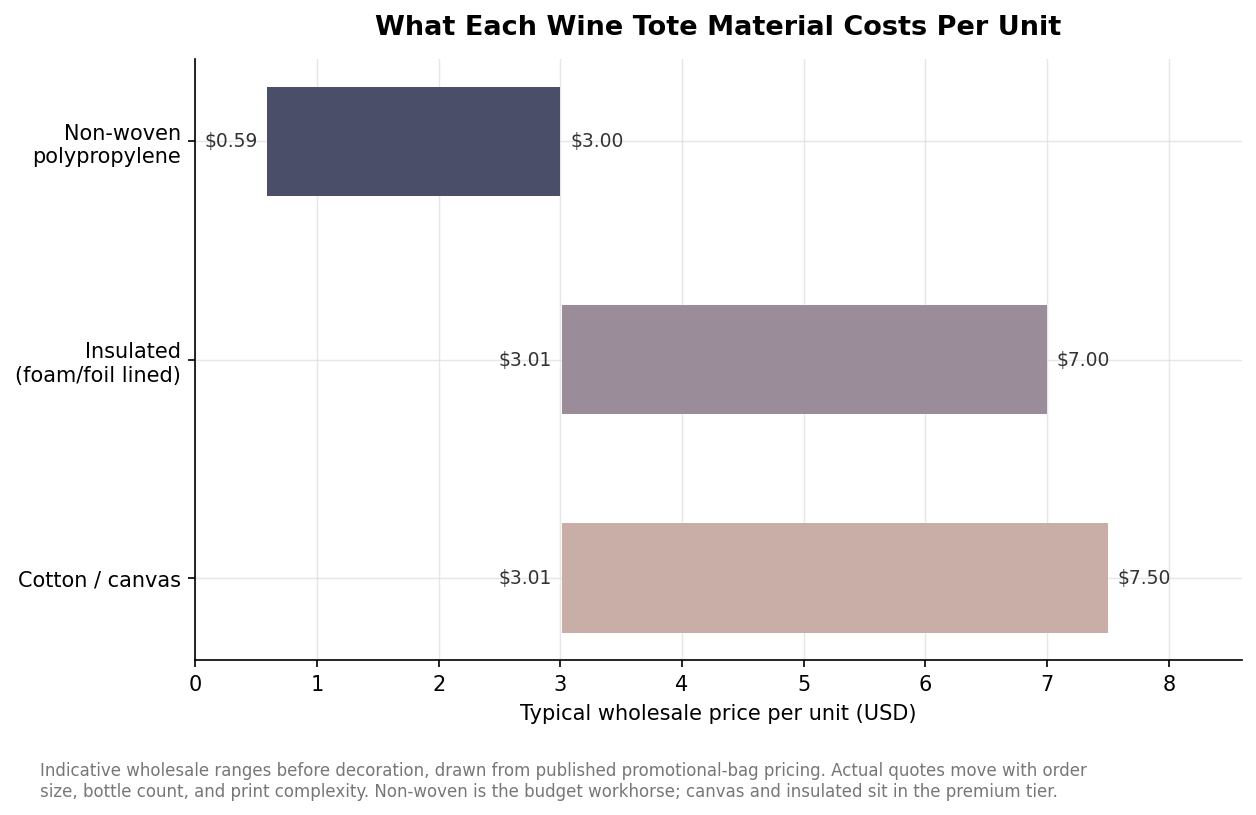
Price is only half the story, though. Non-woven and insulated totes are rated for around 300 uses with spot-cleaning, while cotton canvas lasts for years and is machine washable, which is why it feels like an heirloom rather than a giveaway. Match the durability to how the tote will live: a promotional bag handed out once needs 300 uses far less than a wine-club bag a customer reaches for every week.
High-volume retail, tasting rooms, and giveaways
If you are ordering in the hundreds or thousands for a tasting room counter, a retail add-on, or an event giveaway, non-woven polypropylene is almost always the right answer. It takes a screen print cleanly in one to four colors, comes in every common format from one to six bottles, and turns around fast, often in four to five days once art is approved. The trade is that minimums tend to start around 200 units, so it rewards volume rather than small runs. For this use case, spend your attention on the print, not the bag: a bold, legible logo on an inexpensive tote does exactly the job it needs to, and nobody expects a free bag to be luxurious.
Premium gifts, wine clubs, and boutique wineries
When the tote itself is part of the impression, cotton or canvas earns its higher price. It signals quality through the feel of the natural fabric, survives years of regular use, and washes clean, all of which matter when a customer is meant to keep and reuse it. Canvas also carries the lowest minimums, often around 100 units, which suits boutique wineries and clubs ordering in smaller batches, though turnaround runs a little longer at roughly five to ten days. Canvas totes are most commonly produced as two-bottle formats, which happens to be the sweet spot for a gift or a club shipment. If your brand lives or dies on perceived quality, the extra few dollars per unit is the cheapest brand investment you will make all year.
Warm weather, festivals, and long drives
The moment temperature enters the picture, insulation stops being a luxury and becomes the whole point. A foam- or foil-lined tote holds wine near its serving temperature for roughly two to four hours, which is the difference between a crisp white at an outdoor festival and a warm, flat disappointment.
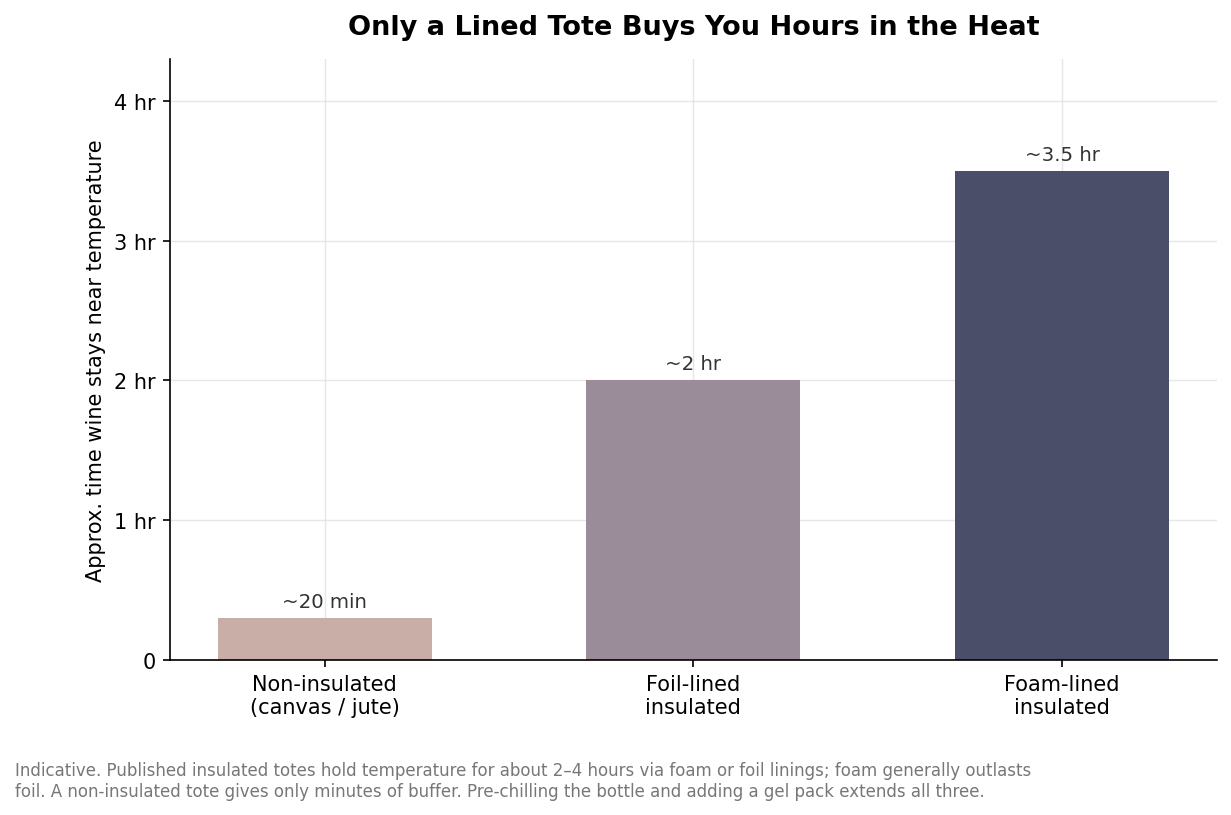
Foam linings generally outlast foil, and a non-insulated canvas or jute tote gives you only minutes of buffer before ambient heat takes over. Insulated totes commonly ship with sewn-in dividers and come in one-, four-, and six-bottle formats, with the same 300-use durability and roughly 200-unit minimums as non-woven. This is the right choice for warm climates, tailgates, poolside events, and any scenario where a customer faces a long, hot drive home from the tasting room. Two practical notes: pre-chill the bottle before it goes in, because insulation slows heat transfer but cannot cool a warm bottle, and add a slim gel pack when you need to stretch past a couple of hours.
Then choose the format: one, two, four, or six bottles
Once the material is settled, the format follows the trip. A single-bottle carrier suits restaurant BYOB visits, housewarming gifts, and one special bottle. A two-bottle tote is the everyday gift and dinner-party size, and it is the most common canvas format for good reason. A four-bottle bag fits family gatherings and wine-shopping trips where a customer wants a few choices, and a six-bottle carrier is the serious-collector and large-gathering option that demands robust construction because it can carry close to ten kilograms when full. Whatever the count, insist on double-stitched, reinforced handles and padded or stitched dividers on any multi-bottle format, since those two features are what separate a tote that survives a season from one that fails on its first heavy load. Order a printed sample in your chosen material and format before committing to the full run; a single proof confirms the fit, the print, and the build far more reliably than any spec sheet, including this one, whose figures are indicative and meant only to point you to the right tier.