An insulated wine tote looks like a padded bag, but it is really a small thermal system, and how well it works comes down to a stack of layers most buyers never see. Unlike a plain canvas carrier, an insulated tote is asked to do a specific job: hold a bottle near its serving temperature while it travels from a fridge to a table, a park, or a client’s office. Understanding the materials that do that work lets you spec a tote that actually performs, rather than one that merely looks the part.
Start from the temperature you are trying to protect
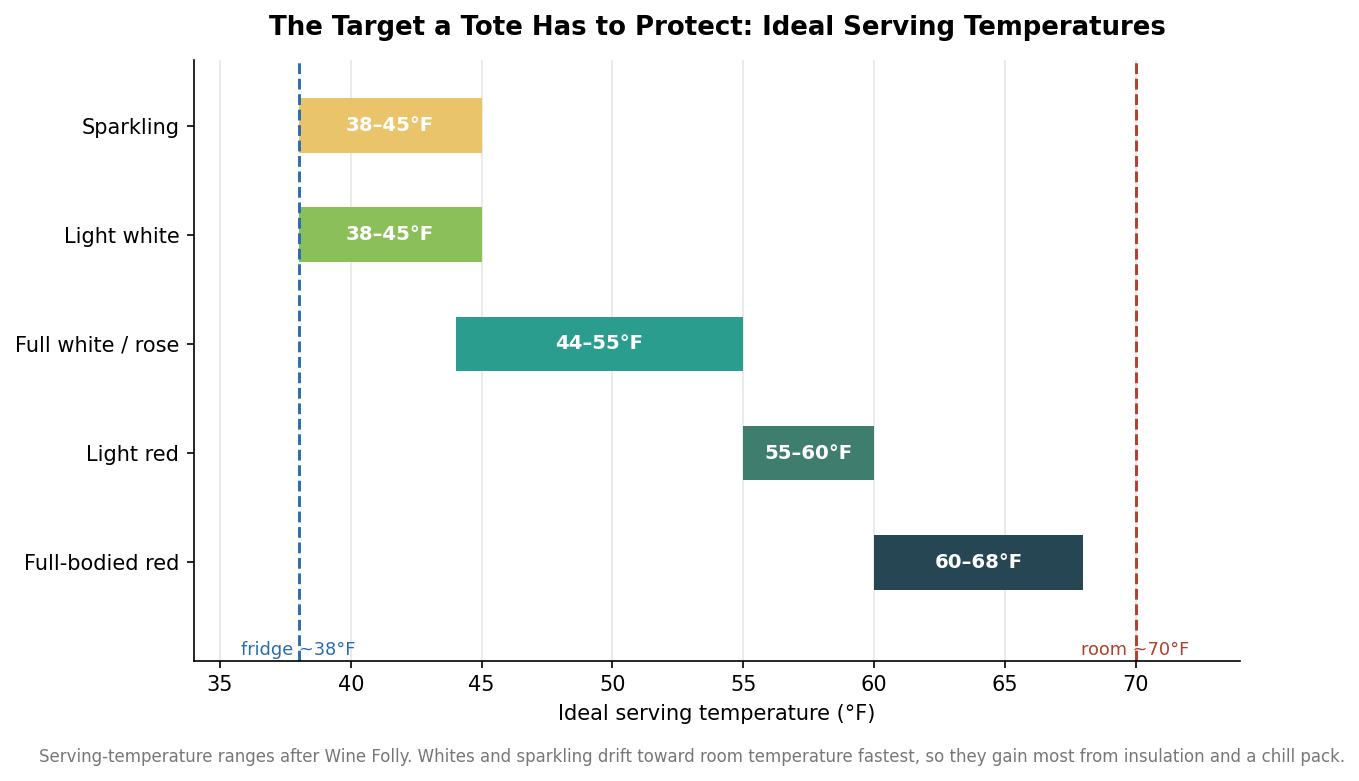
Insulation only makes sense once you know the target. Wine has fairly narrow serving windows: sparkling and light whites show best at roughly 38 to 45°F, fuller whites and rosé around 44 to 55°F, light reds near 55 to 60°F, and full-bodied reds around 60 to 68°F. That range matters for tote design because the further a wine’s ideal sits from ambient temperature, the harder the tote has to work. A chilled sparkling wine pulled from a 38°F fridge into a 70°F room is fighting a 30-degree gradient and will warm quickly, while a light red only needs to be held a few degrees below room temperature. The honest way to think about a tote is that it slows the drift back toward ambient; it does not refrigerate. Everything below is about how to slow that drift for longer.
The insulating core does most of the work
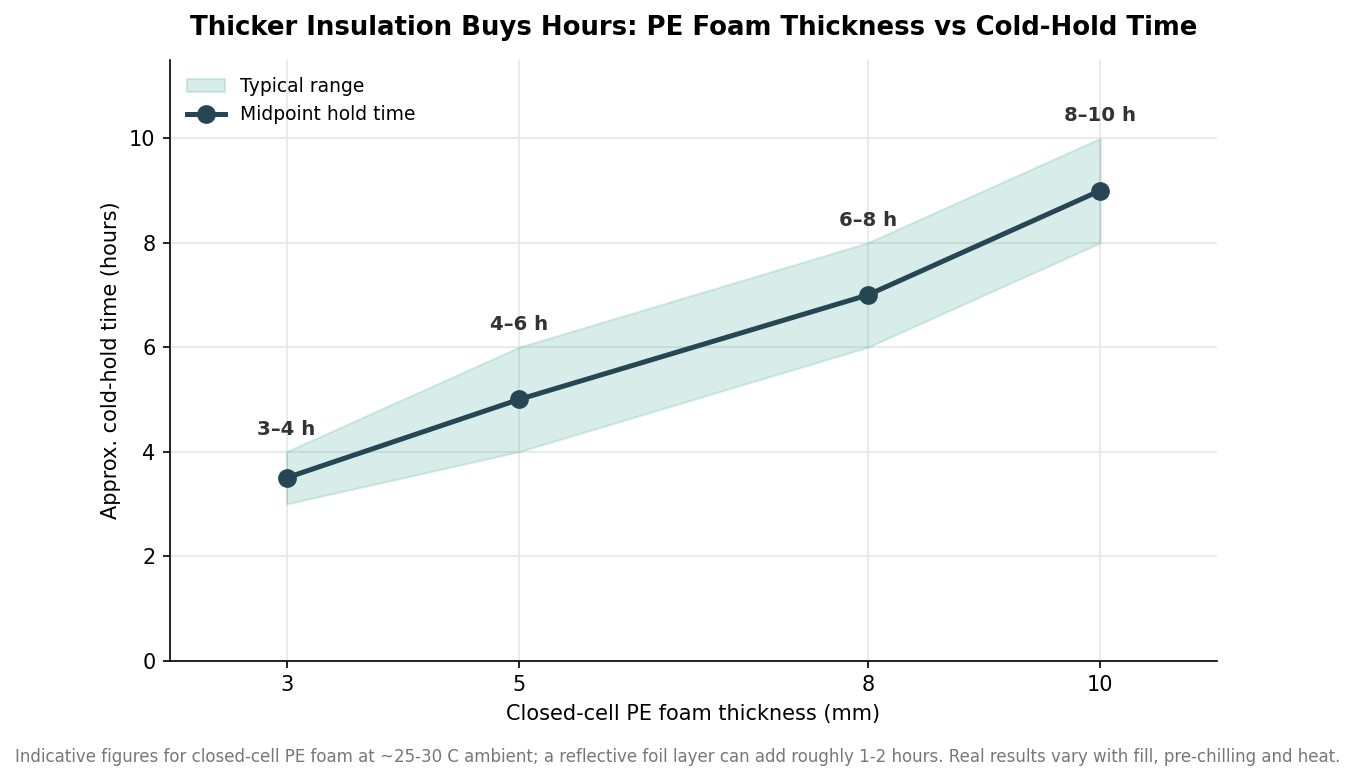
The heart of an insulated tote is a foam layer, and not all foam is equal. Entry-level bags often use EPE foam, which has a looser cell structure and only moderate insulating power. The industry standard is closed-cell PE foam, with a thermal conductivity in the region of 0.033 to 0.040 watts per meter-kelvin, low enough to resist heat flow well. Denser EVA foam insulates a little better and resists compression, at a cost premium of roughly twenty to thirty percent. Thickness is the lever that moves hold time most directly. As a rough guide under normal warm conditions, about 3 millimeters of PE foam buys three to four hours of useful cold, 5 millimeters four to six hours, 8 millimeters six to eight hours, and 10 millimeters eight to ten hours. Those are indicative figures rather than promises, because fill level, pre-chilling, and outside heat all shift them, but the direction is reliable: if you need a tote to last a full afternoon, specify the foam thickness rather than trusting the word insulated.
A radiant barrier adds cheap extra margin
Foam slows heat that conducts through the walls, but a lot of warming also arrives as radiant heat, and that is where a reflective inner layer earns its place. A simple aluminum foil lining reflects on the order of 95 to 97 percent of radiant heat and costs very little, which is why it is the most common choice. A metallized film reflects slightly less, around 90 to 92 percent, but survives flexing and abrasion better over a bag’s life. Adding a reflective layer typically extends cold-hold time by roughly one to two hours in hot conditions, so the combination most quality totes use, closed-cell foam plus a foil or metallized inner face, is not marketing dressing but a genuine performance pairing. When you evaluate a sample, look inside: a bright, intact reflective liner is doing real work.
Liners and the outer shell decide durability
The innermost surface has to be waterproof, because condensation and the occasional spill are inevitable. PEVA is the popular liner: waterproof, BPA-free, flexible, and food-safe, which suits a tote that may also carry a chilled snack. TPU costs more, around twenty to thirty percent above PEVA, and repays it with better durability and puncture resistance for totes that see heavy use. PVC is cheaper but carries environmental and safety trade-offs that many brands now avoid. On the outside, the shell fabric protects the whole stack and carries your branding; a mid-weight woven such as a 600-denier polyester is a common, hard-wearing choice that also decorates cleanly. The outer does little for insulation directly, but a tough shell keeps the foam and liner intact, and a tote only holds temperature as long as its layers stay unbroken.
Turning materials into real-world hold time
Even a well-built tote is a passive device, so the last few degrees come from how it is used. Pre-chilling the bottle and the tote, packing it full so there is little warm air to cool, and slipping in a frozen gel pack all extend the useful window well beyond what the foam alone provides, because the gel pack adds active cooling rather than just resistance to warming. Ambient heat cuts the other way: the same tote that holds eight hours in a mild room may manage far less in a hot car. For planning, treat the foam-thickness figures as a baseline for a warm day, add an hour or two for a reflective liner, and add more still for a chill pack and a pre-cooled load. If you are speccing totes for a winery’s summer events, that math argues for thicker foam and a gel-pack pocket; for indoor retail gifting, a lighter build is plenty. Match the construction to the hottest realistic trip, and the tote will quietly do its job every time.
An insulated wine tote is only as good as the layers inside it: a closed-cell foam core sized in millimeters to the hold time you need, a reflective barrier to turn back radiant heat, a waterproof liner chosen for how hard the bag will work, and a shell tough enough to keep it all intact. Specify those deliberately, plan for a gel pack and a pre-chill, and you can promise a serving temperature rather than hope for one.