The price on a custom wine tote is really three numbers stacked together: the blank bag itself, the decoration on it, and the one-time setup to make that decoration possible. Each behaves differently as your quantity changes, and a quote that looks expensive at 100 pieces can look very reasonable at 1,000. Understanding how the three move is the difference between guessing at a budget and knowing where your money actually goes.
The figures below are indicative industry ranges drawn from current wholesale pricing guides, not a single vendor’s rate card. Blank prices, setup fees, and lead times vary with material, decoration, order size, and where the bags are made, so use these as a framework for reading a quote rather than as a promise of any particular price.
The blank bag price moves with quantity
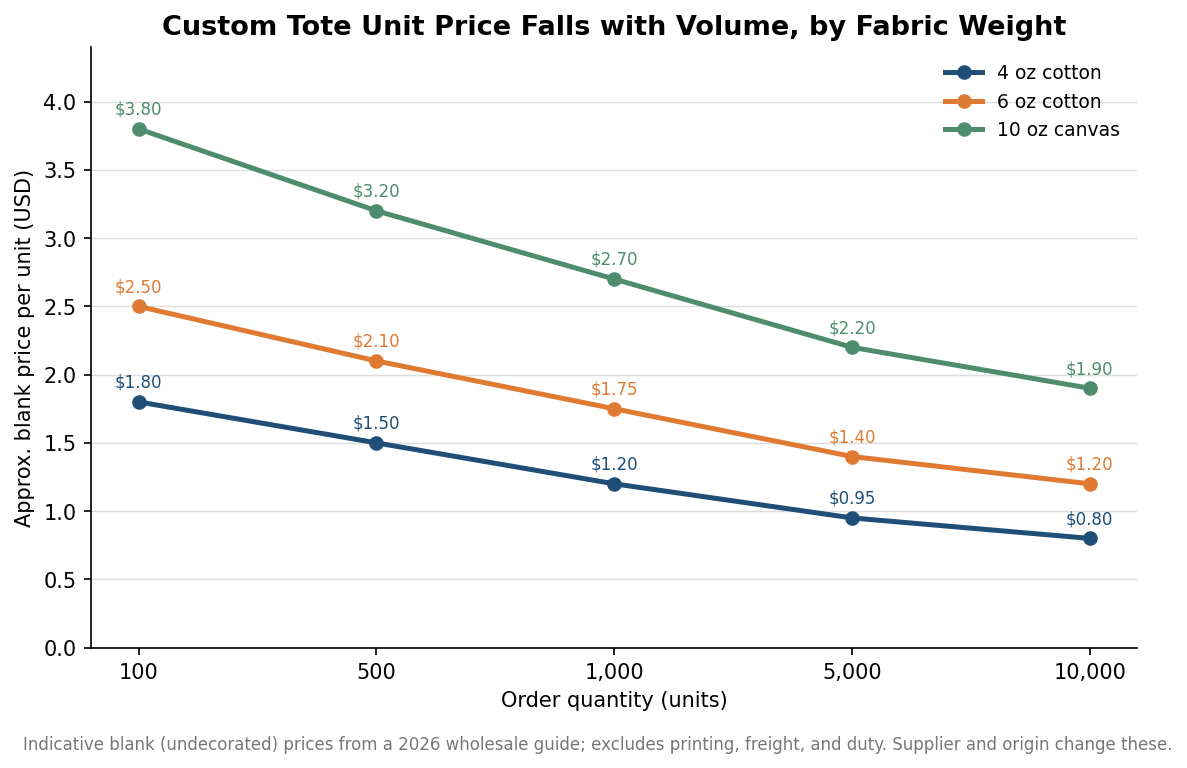
Before any printing, the undecorated tote has a base cost that falls as you order more. The drop is steepest early: across common cotton and canvas weights, moving from 100 units to 1,000 units often takes 30 to 40 percent off the per-piece price, after which the curve flattens. Fabric weight sets the starting height of that curve. A light 4-ounce cotton tote might begin near $1.80 each at 100 pieces and settle under a dollar in the thousands, while a sturdy 10-ounce canvas starts closer to $3.80 and lands around $1.90 at high volume.
Non-woven polypropylene wine bags sit below all of that, frequently in the $0.60 to $3.00 range depending on size and finish, which is why they dominate high-volume giveaways. Cotton, jute, and insulated styles cluster higher, commonly $3 to $7 before decoration, and premium builds with rigid bases or specialty materials run higher still. The chart below shows how the blank price declines across order sizes for three fabric weights.
Minimum order quantities set your floor
Every material carries a minimum order quantity, and it is often the first constraint that shapes a project. Cotton totes commonly start around 100 units. Non-woven bags frequently require about 200 because the tooling and print setup only make sense across a larger run. Insulated styles land in between, roughly 100 to 200 depending on construction, and fully laminated bags with edge-to-edge printing can demand minimums of 2,500 or more because they are produced as a custom manufacturing run rather than decorated from stock.
The MOQ interacts with the price curve in a way worth planning around. If a material’s minimum is 200 but the unit price keeps falling to 500, the jump from 200 to 250 or 500 units may cost far less per piece while adding only modestly to the total. It is routinely worth pricing the tier just above your immediate need, because price breaks tend to land at predictable thresholds of 250, 500, 1,000, 2,500, and 5,000 units.
Decoration is a separate line item
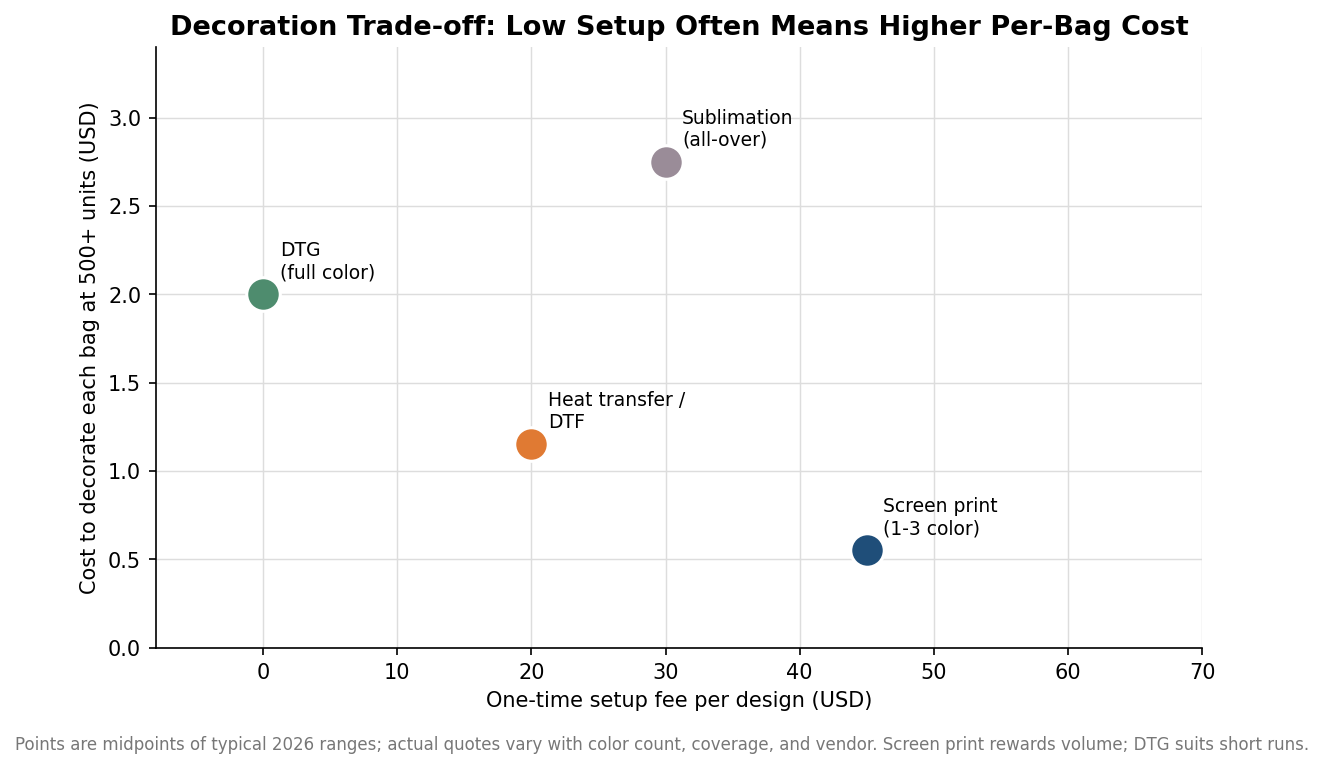
The print or embroidery on the bag is quoted apart from the blank, and the method you choose changes both a fixed setup fee and a per-bag cost. Screen printing carries a setup charge that commonly runs $30 to $60 per color because a physical screen has to be burned for each one, but the per-bag cost afterward is low, often $0.30 to $0.80 at 500 pieces and up. That structure rewards volume and simple, few-color artwork.
Digital methods invert the math. Direct-to-garment and heat-transfer or DTF printing carry little or no setup, so they suit short runs and full-color art, but the per-bag cost is higher, roughly $0.80 to $1.50 for heat transfer and $1.50 to $2.50 for DTG. All-over sublimation sits at the top for both, since it prints the fabric before the bag is sewn. The scatter below plots that trade-off: the low-setup methods carry the highest per-piece cost, and the high-setup method is cheapest to repeat.
The extras that surprise buyers
Two costs live outside the bag-and-print quote and catch first-time buyers off guard. The first is freight and duty on imported bags. Ocean freight commonly adds something like $0.15 to $0.30 per unit, and import duty depends heavily on country of origin; some origins carry single-digit percentage duties while certain Chinese-made goods have faced additional tariffs as high as 25 percent under Section 301. On a large order those percentages are real money, so it is worth asking a supplier whether a quote is landed cost or ex-works.
The second is time. Decorating bags that are already in a domestic warehouse can take only a few business days, but a custom production run made to order typically needs two to four weeks after artwork approval, and factory-direct imports often run four to six weeks before they even ship. If a bag is tied to a wine release, a holiday, or an event date, that calendar matters as much as the price, and rushing it usually costs extra.
Estimating your all-in cost per bag
To turn all of this into a working budget, add the three pieces and spread the setup across your quantity. Start with the blank at your target volume, add the per-bag decoration cost for your chosen method, then divide the one-time setup by the number of units so it lands as a per-piece figure. A one-color screen print on a 6-ounce cotton tote at 500 units, for example, might combine a blank near $2.10, decoration near $0.50, and a $50 setup that works out to a dime per bag — a very different all-in number than the same art printed full-color on 50 bags, where the setup barely spreads at all.
That arithmetic is also why quantity and method should be decided together rather than in sequence. The cheapest path for 100 gift totes and the cheapest path for 2,500 event totes are rarely the same method, and locking in artwork before you have settled on volume can leave you paying setup fees that a different quantity would have erased. Price the tiers, match the decoration to the run length, and confirm whether freight and duty are already in the number before you compare one supplier’s quote to another.