Category: Uncategorized

  • What Custom Wine Totes Cost in Bulk: MOQs, Price Breaks, and Decoration Fees

    What Custom Wine Totes Cost in Bulk: MOQs, Price Breaks, and Decoration Fees

    The price on a custom wine tote is really three numbers stacked together: the blank bag itself, the decoration on it, and the one-time setup to make that decoration possible. Each behaves differently as your quantity changes, and a quote that looks expensive at 100 pieces can look very reasonable at 1,000. Understanding how the three move is the difference between guessing at a budget and knowing where your money actually goes.

    The figures below are indicative industry ranges drawn from current wholesale pricing guides, not a single vendor’s rate card. Blank prices, setup fees, and lead times vary with material, decoration, order size, and where the bags are made, so use these as a framework for reading a quote rather than as a promise of any particular price.

    The blank bag price moves with quantity

    Before any printing, the undecorated tote has a base cost that falls as you order more. The drop is steepest early: across common cotton and canvas weights, moving from 100 units to 1,000 units often takes 30 to 40 percent off the per-piece price, after which the curve flattens. Fabric weight sets the starting height of that curve. A light 4-ounce cotton tote might begin near $1.80 each at 100 pieces and settle under a dollar in the thousands, while a sturdy 10-ounce canvas starts closer to $3.80 and lands around $1.90 at high volume.

    Non-woven polypropylene wine bags sit below all of that, frequently in the $0.60 to $3.00 range depending on size and finish, which is why they dominate high-volume giveaways. Cotton, jute, and insulated styles cluster higher, commonly $3 to $7 before decoration, and premium builds with rigid bases or specialty materials run higher still. The chart below shows how the blank price declines across order sizes for three fabric weights.
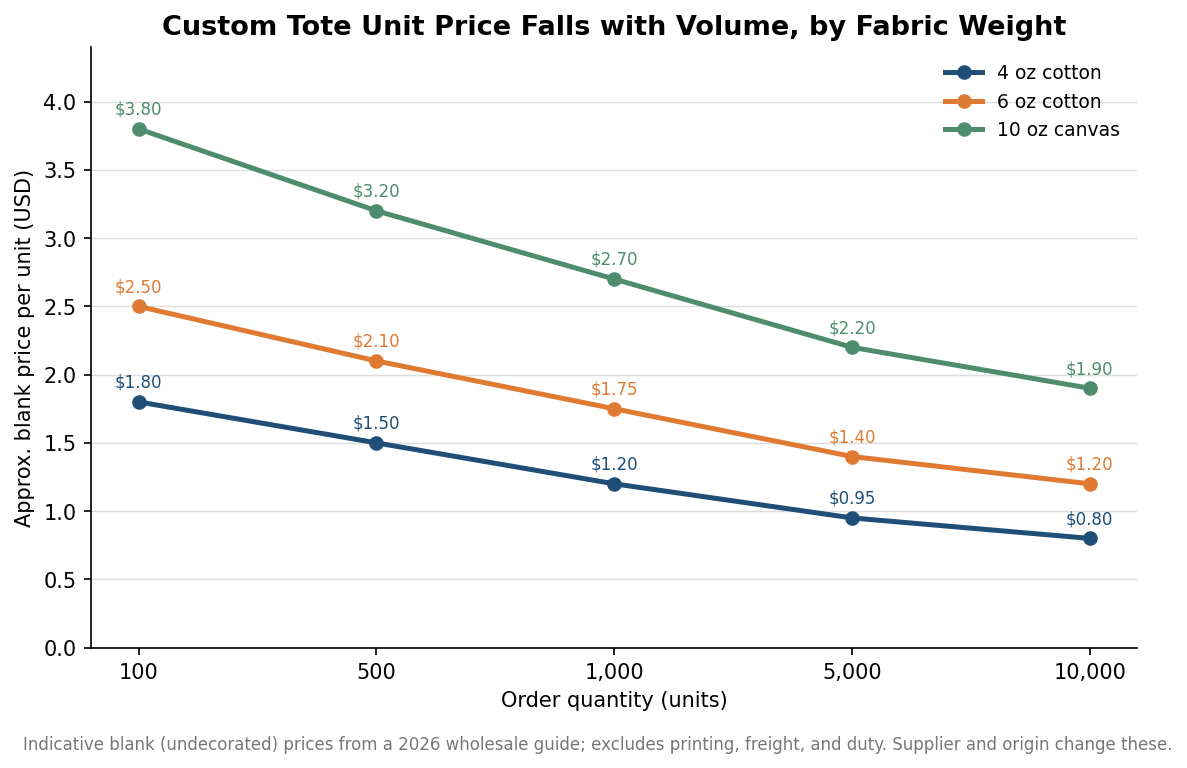
    Line chart showing per-unit blank price of custom totes falling as order quantity rises, for 4 oz cotton, 6 oz cotton, and 10 oz canvas.
    The blank price drops fastest between 100 and 1,000 units, then flattens.

    Minimum order quantities set your floor

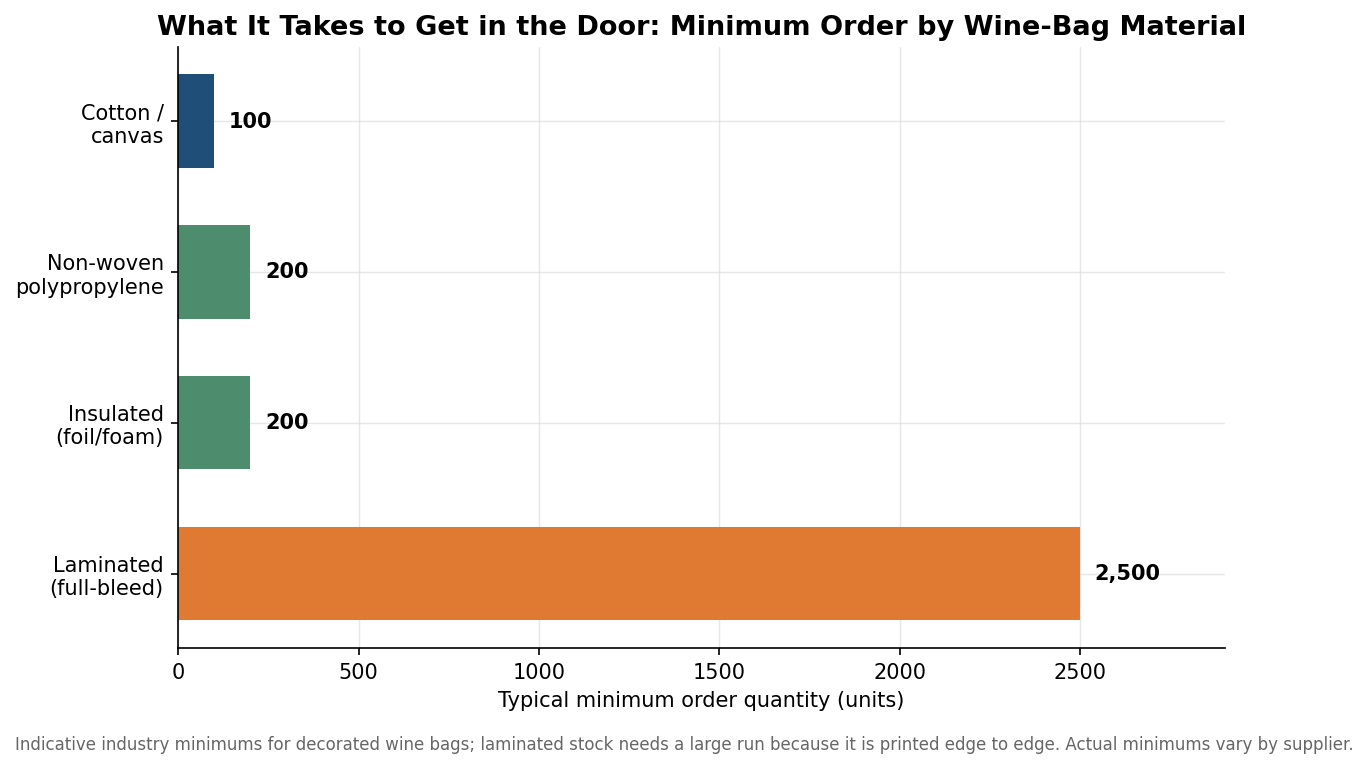
    Every material carries a minimum order quantity, and it is often the first constraint that shapes a project. Cotton totes commonly start around 100 units. Non-woven bags frequently require about 200 because the tooling and print setup only make sense across a larger run. Insulated styles land in between, roughly 100 to 200 depending on construction, and fully laminated bags with edge-to-edge printing can demand minimums of 2,500 or more because they are produced as a custom manufacturing run rather than decorated from stock.

    The MOQ interacts with the price curve in a way worth planning around. If a material’s minimum is 200 but the unit price keeps falling to 500, the jump from 200 to 250 or 500 units may cost far less per piece while adding only modestly to the total. It is routinely worth pricing the tier just above your immediate need, because price breaks tend to land at predictable thresholds of 250, 500, 1,000, 2,500, and 5,000 units.

    Decoration is a separate line item

    The print or embroidery on the bag is quoted apart from the blank, and the method you choose changes both a fixed setup fee and a per-bag cost. Screen printing carries a setup charge that commonly runs $30 to $60 per color because a physical screen has to be burned for each one, but the per-bag cost afterward is low, often $0.30 to $0.80 at 500 pieces and up. That structure rewards volume and simple, few-color artwork.

    Digital methods invert the math. Direct-to-garment and heat-transfer or DTF printing carry little or no setup, so they suit short runs and full-color art, but the per-bag cost is higher, roughly $0.80 to $1.50 for heat transfer and $1.50 to $2.50 for DTG. All-over sublimation sits at the top for both, since it prints the fabric before the bag is sewn. The scatter below plots that trade-off: the low-setup methods carry the highest per-piece cost, and the high-setup method is cheapest to repeat.
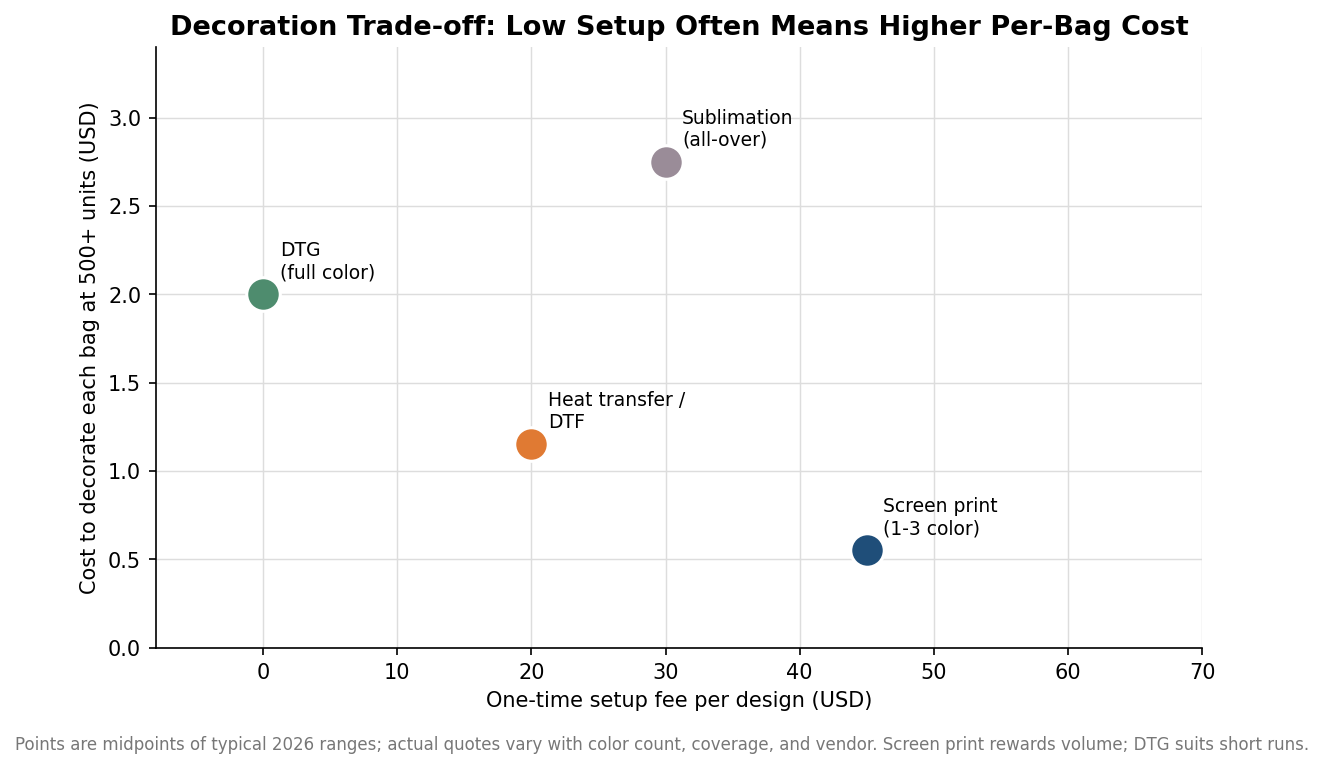
    Scatter plot of decoration methods showing setup fee versus per-bag cost, with screen print low per-bag but high setup and DTG the reverse.
    Screen printing trades a higher setup fee for the lowest cost to repeat; digital methods do the opposite.

    The extras that surprise buyers

    Two costs live outside the bag-and-print quote and catch first-time buyers off guard. The first is freight and duty on imported bags. Ocean freight commonly adds something like $0.15 to $0.30 per unit, and import duty depends heavily on country of origin; some origins carry single-digit percentage duties while certain Chinese-made goods have faced additional tariffs as high as 25 percent under Section 301. On a large order those percentages are real money, so it is worth asking a supplier whether a quote is landed cost or ex-works.

    The second is time. Decorating bags that are already in a domestic warehouse can take only a few business days, but a custom production run made to order typically needs two to four weeks after artwork approval, and factory-direct imports often run four to six weeks before they even ship. If a bag is tied to a wine release, a holiday, or an event date, that calendar matters as much as the price, and rushing it usually costs extra.

    Estimating your all-in cost per bag

    To turn all of this into a working budget, add the three pieces and spread the setup across your quantity. Start with the blank at your target volume, add the per-bag decoration cost for your chosen method, then divide the one-time setup by the number of units so it lands as a per-piece figure. A one-color screen print on a 6-ounce cotton tote at 500 units, for example, might combine a blank near $2.10, decoration near $0.50, and a $50 setup that works out to a dime per bag — a very different all-in number than the same art printed full-color on 50 bags, where the setup barely spreads at all.

    That arithmetic is also why quantity and method should be decided together rather than in sequence. The cheapest path for 100 gift totes and the cheapest path for 2,500 event totes are rarely the same method, and locking in artwork before you have settled on volume can leave you paying setup fees that a different quantity would have erased. Price the tiers, match the decoration to the run length, and confirm whether freight and duty are already in the number before you compare one supplier’s quote to another.
  • How to Specify a Custom Wine Tote: Print Method, Colors, and Artwork That Land

    How to Specify a Custom Wine Tote: Print Method, Colors, and Artwork That Land

    The material of a wine tote gets most of the attention, but the thing that makes a bag look like your bag is the decoration on the panel, and that decision is where most orders go sideways. Pick the wrong method and a two-color logo turns into a four-figure setup bill, or a photographic label comes back looking like a rubber stamp. This is a walkthrough for specifying the print on a custom wine tote so the proof matches what is in your head and the invoice matches what is in your budget.

    Choose the decoration method before you touch the artwork

    There are three methods that cover almost every wine tote made, and they are not interchangeable. Screen printing pushes ink through a stencil, one screen per color. It lays down opaque, durable spot colors and is the default for cotton, canvas, and non-woven bags in any real quantity. Heat transfer, including the digital DTF (direct-to-film) process that has largely replaced older vinyl transfers, presses a pre-printed graphic onto the fabric. It reproduces gradients, photographs, and unlimited colors without a separate screen for each one. Embroidery stitches the design in thread rather than printing it, which reads as premium and survives years of washing, but it cannot hold fine detail and is priced by stitch count rather than by color.

    The practical rule is that the method should follow the artwork and the quantity, not your preference. A crisp one- or two-color logo on a few hundred canvas totes is a screen-printing job. A full-color winery label with a photographic vineyard shot is a heat-transfer job. A monogram or a coat of arms on a small run of gift totes is an embroidery job. Trying to force any of these onto the wrong method is the single most common reason a first proof gets rejected.

    Count your colors, because that is what you are really paying for

    With screen printing, cost is driven less by the number of bags than by the number of colors. Each spot color needs its own screen, its own setup, and its own pass on the press, so a one-color print is dramatically cheaper to start than a four-color one at the same quantity. Most logos live comfortably in one to three colors, and if yours does, screen printing will almost always be the cheapest route once you are past a hundred pieces or so. If your art has gradients, drop shadows, or a photographic element, you are no longer counting colors at all, and heat transfer becomes both easier and often cheaper because it ignores color count entirely.

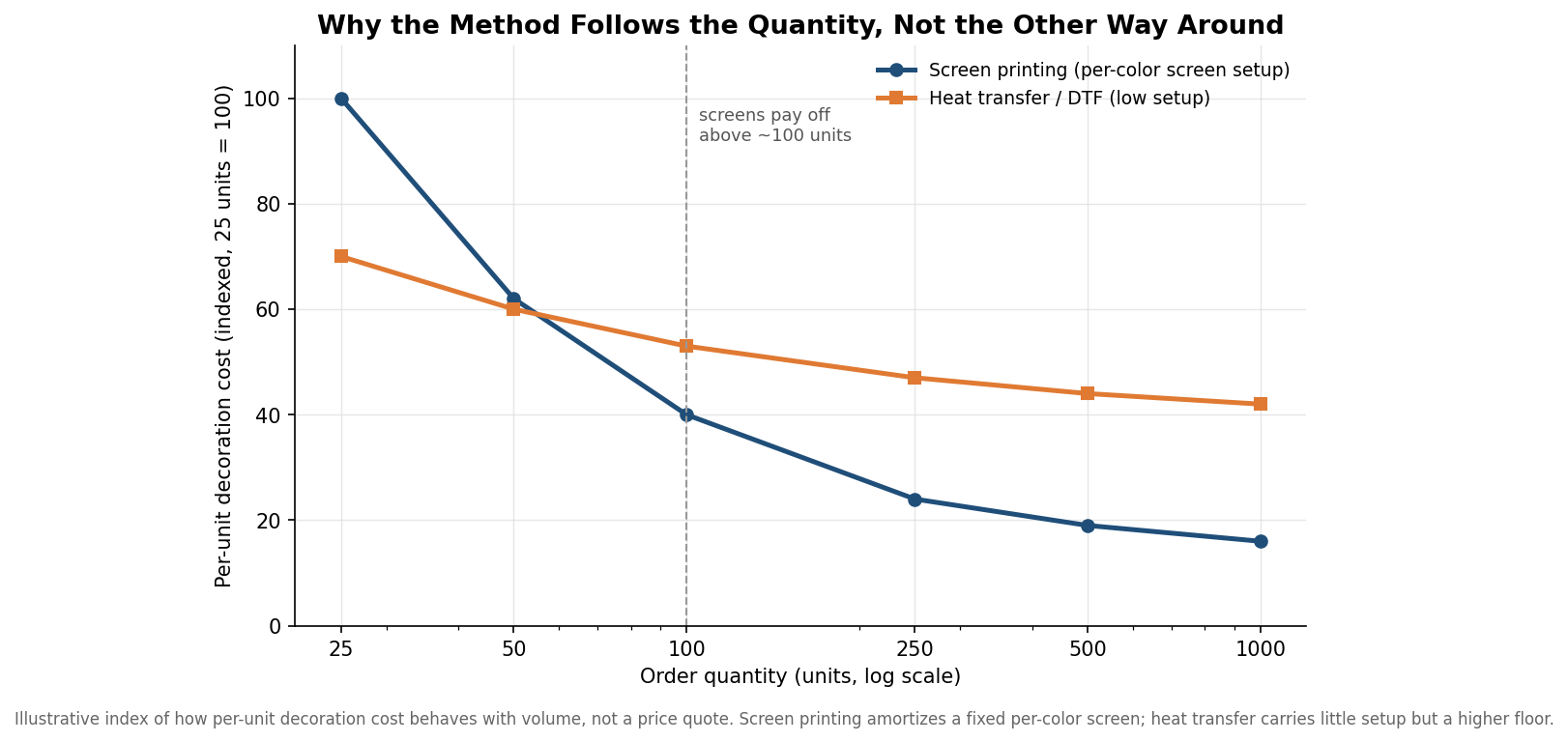
    The chart below is an illustrative index rather than a price list, but it captures the economics that matter. Screen printing carries a fixed per-color setup that gets spread across the run, so its per-unit cost falls steeply as quantity climbs. Heat transfer carries almost no setup but sits on a higher per-piece floor. The two cross somewhere in the low hundreds, which is exactly why a supplier will steer a 50-bag order toward transfer and a 500-bag order toward screens.

    Line chart showing indexed per-unit decoration cost falling with order quantity, screen printing dropping steeply and heat transfer staying flatter, crossing near 100 units
    Screen printing wins on volume; heat transfer wins on small runs and complex color.

    Embroidery follows a third logic. You pay a one-time digitizing fee to convert your logo into a stitch file, and then each bag is priced by how many stitches it takes to sew. A palm-sized mark is often somewhere in the range of 5,000 to 15,000 stitches; the exact figure depends on fill area, not on how many colors of thread you use. Fine text below roughly a quarter inch tends to blur into the weave, so embroidery rewards simple, bold shapes and punishes busy logos.

    Get the brand color and the file right the first time

    Whatever method you choose, two artwork details decide whether the proof is usable. The first is color specification. Do not describe your brand color as “navy” and hope; give the supplier a Pantone (PMS) number so the ink or transfer is mixed to a defined target. Screens and DTF can both hit a Pantone reference closely, though a printed color on natural canvas will always read slightly warmer than the same ink on white non-woven, because the fabric shows through. The second detail is file format. Screen printing and embroidery both want vector art, an AI, EPS, or vector PDF, because the design has to be separated cleanly into colors or stitch paths. Heat transfer will accept a high-resolution raster file, but it needs to be at least 300 dpi at the actual print size, not a logo pulled off a website.

    Size the art to the panel, not to the page. A single-bottle wine tote gives you a usable imprint area of roughly three-and-a-half to four inches wide on the front face; a two-bottle or six-bottle tote gives you more room but also more curved and seamed real estate to avoid. Keep the design clear of zippers, handles, and side seams by at least a finger’s width, because ink and transfers do not lie down well over a fold.

    Know the minimums and where the price actually breaks

    Every decorated wine bag carries a minimum order, and it varies more by material than by print method. Cotton and canvas totes tend to start around 100 units, non-woven and insulated styles around 200, and fully laminated bags with edge-to-edge printing often require a run in the thousands because the graphic is manufactured into the material rather than applied afterward.

    Horizontal bar chart of typical minimum order quantities for wine bags by material: cotton or canvas 100, non-woven 200, insulated 200, laminated 2500 units
    Minimum order quantities are set mostly by the material, not the print method.

    Unit pricing steps down at quantity breaks that are worth planning around. As a rough indication, a lightweight non-woven wine bag can land under three dollars a unit at a couple hundred pieces, while a heavier canvas or insulated tote sits well above that, and moving from 200 to 300 units often trims the per-unit price by ten to twenty percent because the fixed setup is spread wider. If you are close to a break, it is frequently cheaper per bag to order up to it than to sit just below. When you genuinely need fewer than a hundred, the honest answer is usually to buy blank stock and brand it with a woven hang tag, a stamped kraft card, or a sticker rather than paying small-run decoration premiums.

    Proof, then plan the calendar backward

    Ask for a proof before anything goes on press, and read it for the boring things: the Pantone reference, the imprint dimensions in inches, and the placement measured from a seam. A digital proof catches layout errors; a physical pre-production sample, if the run is large enough to justify it, catches how the ink actually sits on that specific fabric. Build in time for it. As a general guide, decorated wine totes run something like two to three weeks in production after art approval for screen printing, a little longer when embroidery digitizing is involved, and longer still for laminated full-bleed bags. If you are ordering for a holiday season, a wedding, or a tasting-room launch, count backward from the date you need them in hand, add a week of slack for a proofing round, and place the order against that deadline rather than the ship date you are hoping for.

    None of this is complicated once the order of operations is right: settle the method against your art and volume, count your colors, lock the Pantone and the file, confirm the minimum and the break points, and never skip the proof. Do that and the tote that arrives is the one you designed, at the price you were quoted.

  • How Insulated Wine Totes Hold Temperature: Foam, Foil, and Real Hold Times

    How Insulated Wine Totes Hold Temperature: Foam, Foil, and Real Hold Times

    An insulated wine tote looks like a padded bag, but it is really a small thermal system, and how well it works comes down to a stack of layers most buyers never see. Unlike a plain canvas carrier, an insulated tote is asked to do a specific job: hold a bottle near its serving temperature while it travels from a fridge to a table, a park, or a client’s office. Understanding the materials that do that work lets you spec a tote that actually performs, rather than one that merely looks the part.

    Start from the temperature you are trying to protect

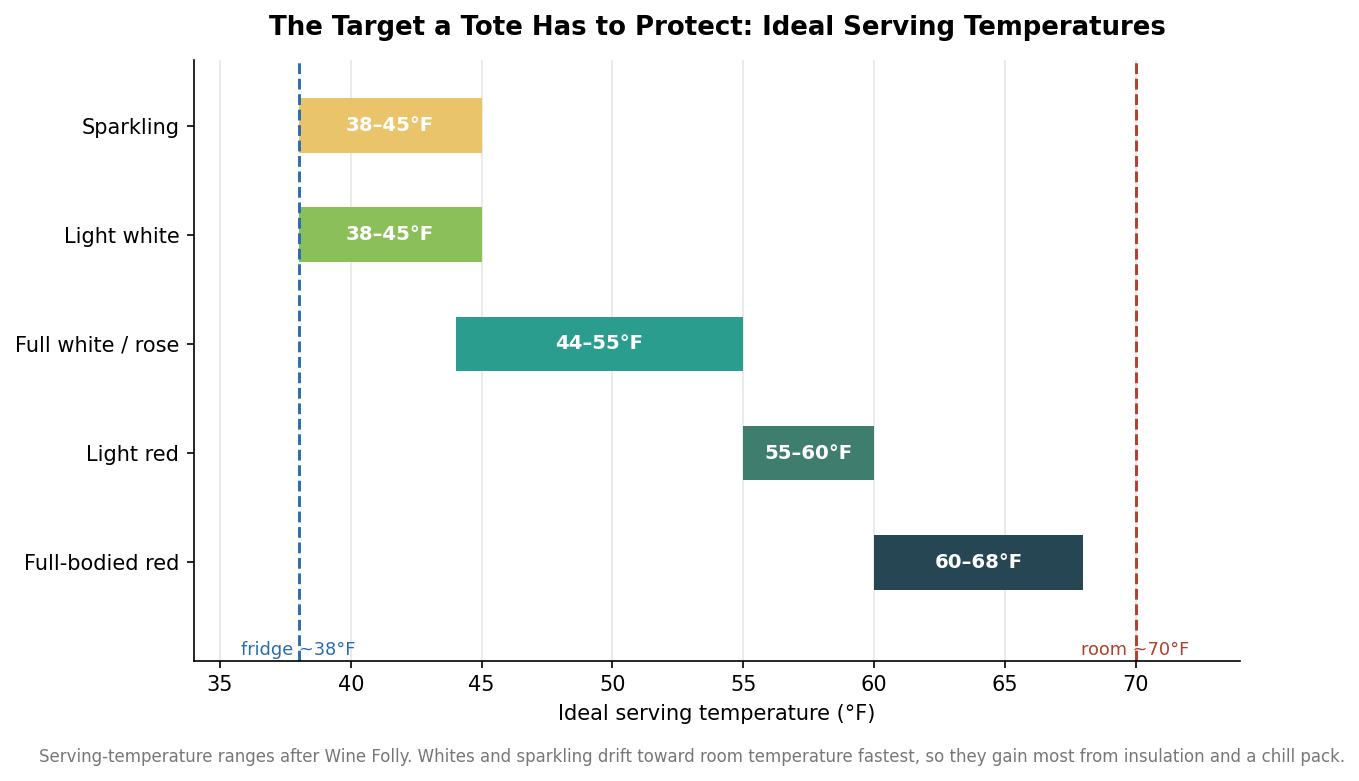
    Insulation only makes sense once you know the target. Wine has fairly narrow serving windows: sparkling and light whites show best at roughly 38 to 45°F, fuller whites and rosé around 44 to 55°F, light reds near 55 to 60°F, and full-bodied reds around 60 to 68°F. That range matters for tote design because the further a wine’s ideal sits from ambient temperature, the harder the tote has to work. A chilled sparkling wine pulled from a 38°F fridge into a 70°F room is fighting a 30-degree gradient and will warm quickly, while a light red only needs to be held a few degrees below room temperature. The honest way to think about a tote is that it slows the drift back toward ambient; it does not refrigerate. Everything below is about how to slow that drift for longer.

    The insulating core does most of the work

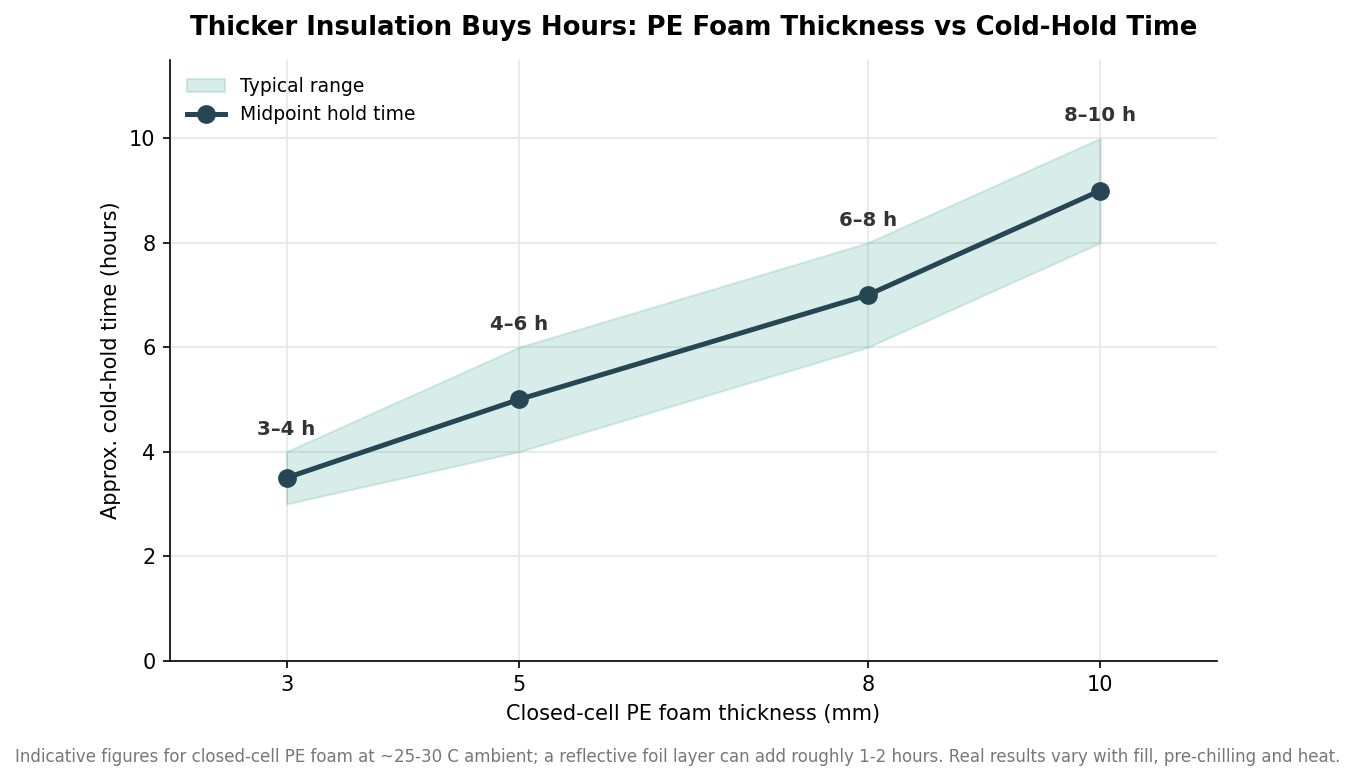
    The heart of an insulated tote is a foam layer, and not all foam is equal. Entry-level bags often use EPE foam, which has a looser cell structure and only moderate insulating power. The industry standard is closed-cell PE foam, with a thermal conductivity in the region of 0.033 to 0.040 watts per meter-kelvin, low enough to resist heat flow well. Denser EVA foam insulates a little better and resists compression, at a cost premium of roughly twenty to thirty percent. Thickness is the lever that moves hold time most directly. As a rough guide under normal warm conditions, about 3 millimeters of PE foam buys three to four hours of useful cold, 5 millimeters four to six hours, 8 millimeters six to eight hours, and 10 millimeters eight to ten hours. Those are indicative figures rather than promises, because fill level, pre-chilling, and outside heat all shift them, but the direction is reliable: if you need a tote to last a full afternoon, specify the foam thickness rather than trusting the word insulated.

    A radiant barrier adds cheap extra margin

    Foam slows heat that conducts through the walls, but a lot of warming also arrives as radiant heat, and that is where a reflective inner layer earns its place. A simple aluminum foil lining reflects on the order of 95 to 97 percent of radiant heat and costs very little, which is why it is the most common choice. A metallized film reflects slightly less, around 90 to 92 percent, but survives flexing and abrasion better over a bag’s life. Adding a reflective layer typically extends cold-hold time by roughly one to two hours in hot conditions, so the combination most quality totes use, closed-cell foam plus a foil or metallized inner face, is not marketing dressing but a genuine performance pairing. When you evaluate a sample, look inside: a bright, intact reflective liner is doing real work.

    Liners and the outer shell decide durability

    The innermost surface has to be waterproof, because condensation and the occasional spill are inevitable. PEVA is the popular liner: waterproof, BPA-free, flexible, and food-safe, which suits a tote that may also carry a chilled snack. TPU costs more, around twenty to thirty percent above PEVA, and repays it with better durability and puncture resistance for totes that see heavy use. PVC is cheaper but carries environmental and safety trade-offs that many brands now avoid. On the outside, the shell fabric protects the whole stack and carries your branding; a mid-weight woven such as a 600-denier polyester is a common, hard-wearing choice that also decorates cleanly. The outer does little for insulation directly, but a tough shell keeps the foam and liner intact, and a tote only holds temperature as long as its layers stay unbroken.

    Turning materials into real-world hold time

    Even a well-built tote is a passive device, so the last few degrees come from how it is used. Pre-chilling the bottle and the tote, packing it full so there is little warm air to cool, and slipping in a frozen gel pack all extend the useful window well beyond what the foam alone provides, because the gel pack adds active cooling rather than just resistance to warming. Ambient heat cuts the other way: the same tote that holds eight hours in a mild room may manage far less in a hot car. For planning, treat the foam-thickness figures as a baseline for a warm day, add an hour or two for a reflective liner, and add more still for a chill pack and a pre-cooled load. If you are speccing totes for a winery’s summer events, that math argues for thicker foam and a gel-pack pocket; for indoor retail gifting, a lighter build is plenty. Match the construction to the hottest realistic trip, and the tote will quietly do its job every time.

    Line chart with range band showing cold-hold time rising with closed-cell PE foam thickness from 3 to 10 mm
    Indicative cold-hold time by PE foam thickness in a warm room; a reflective liner and a gel pack add more.
    Horizontal range chart of ideal serving temperatures by wine style with fridge and room temperature reference lines
    Ideal serving windows by style; the bigger the gap to room temperature, the harder the tote has to work.

    An insulated wine tote is only as good as the layers inside it: a closed-cell foam core sized in millimeters to the hold time you need, a reflective barrier to turn back radiant heat, a waterproof liner chosen for how hard the bag will work, and a shell tough enough to keep it all intact. Specify those deliberately, plan for a gel pack and a pre-chill, and you can promise a serving temperature rather than hope for one.

  • Choosing a Custom Wine Tote by Use Case: Retail, Gifts, and Events

    Choosing a Custom Wine Tote by Use Case: Retail, Gifts, and Events

    Two buyers can order a custom wine tote for completely different reasons and both walk away unhappy if they choose by appearance alone. The winery that hands out five thousand totes a season needs something cheap, fast, and printable. The corporate gifting manager sending bottles to key clients needs something that feels like a keeper. The festival vendor needs a bag that keeps a white wine drinkable in ninety-degree heat. Those are three different products, and the fastest way to get the wrong one is to pick a look first and force the use case to fit it. Work the other way around. Start with who carries the tote, how often, and in what conditions, and the material and format fall out almost automatically.

    The three materials and what they cost

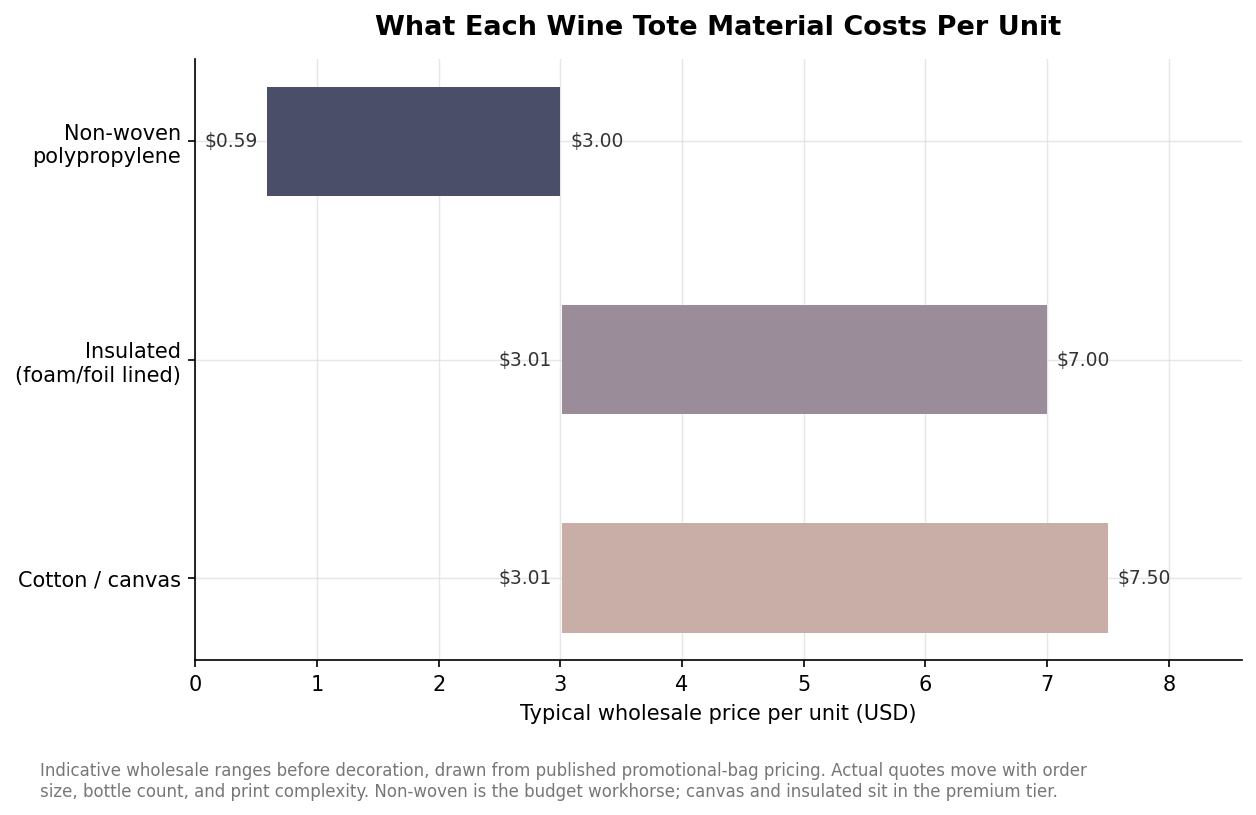
    Nearly every custom wine tote is built from one of three material families, and they separate cleanly by price and by purpose. Non-woven polypropylene is the budget workhorse, typically running well under three dollars a unit before decoration. Cotton or canvas sits in the premium tier, and insulated totes land alongside canvas on price because the lining adds cost. The gap between the cheapest and the most premium option is large enough that the material decision, more than any other, sets your per-unit budget.

    Floating range bar chart of typical per-unit wholesale prices for non-woven, insulated, and cotton canvas wine totes
    Indicative per-unit price ranges by material; non-woven is the budget tier, canvas and insulated the premium tier.

    Price is only half the story, though. Non-woven and insulated totes are rated for around 300 uses with spot-cleaning, while cotton canvas lasts for years and is machine washable, which is why it feels like an heirloom rather than a giveaway. Match the durability to how the tote will live: a promotional bag handed out once needs 300 uses far less than a wine-club bag a customer reaches for every week.

    High-volume retail, tasting rooms, and giveaways

    If you are ordering in the hundreds or thousands for a tasting room counter, a retail add-on, or an event giveaway, non-woven polypropylene is almost always the right answer. It takes a screen print cleanly in one to four colors, comes in every common format from one to six bottles, and turns around fast, often in four to five days once art is approved. The trade is that minimums tend to start around 200 units, so it rewards volume rather than small runs. For this use case, spend your attention on the print, not the bag: a bold, legible logo on an inexpensive tote does exactly the job it needs to, and nobody expects a free bag to be luxurious.

    Premium gifts, wine clubs, and boutique wineries

    When the tote itself is part of the impression, cotton or canvas earns its higher price. It signals quality through the feel of the natural fabric, survives years of regular use, and washes clean, all of which matter when a customer is meant to keep and reuse it. Canvas also carries the lowest minimums, often around 100 units, which suits boutique wineries and clubs ordering in smaller batches, though turnaround runs a little longer at roughly five to ten days. Canvas totes are most commonly produced as two-bottle formats, which happens to be the sweet spot for a gift or a club shipment. If your brand lives or dies on perceived quality, the extra few dollars per unit is the cheapest brand investment you will make all year.

    Warm weather, festivals, and long drives

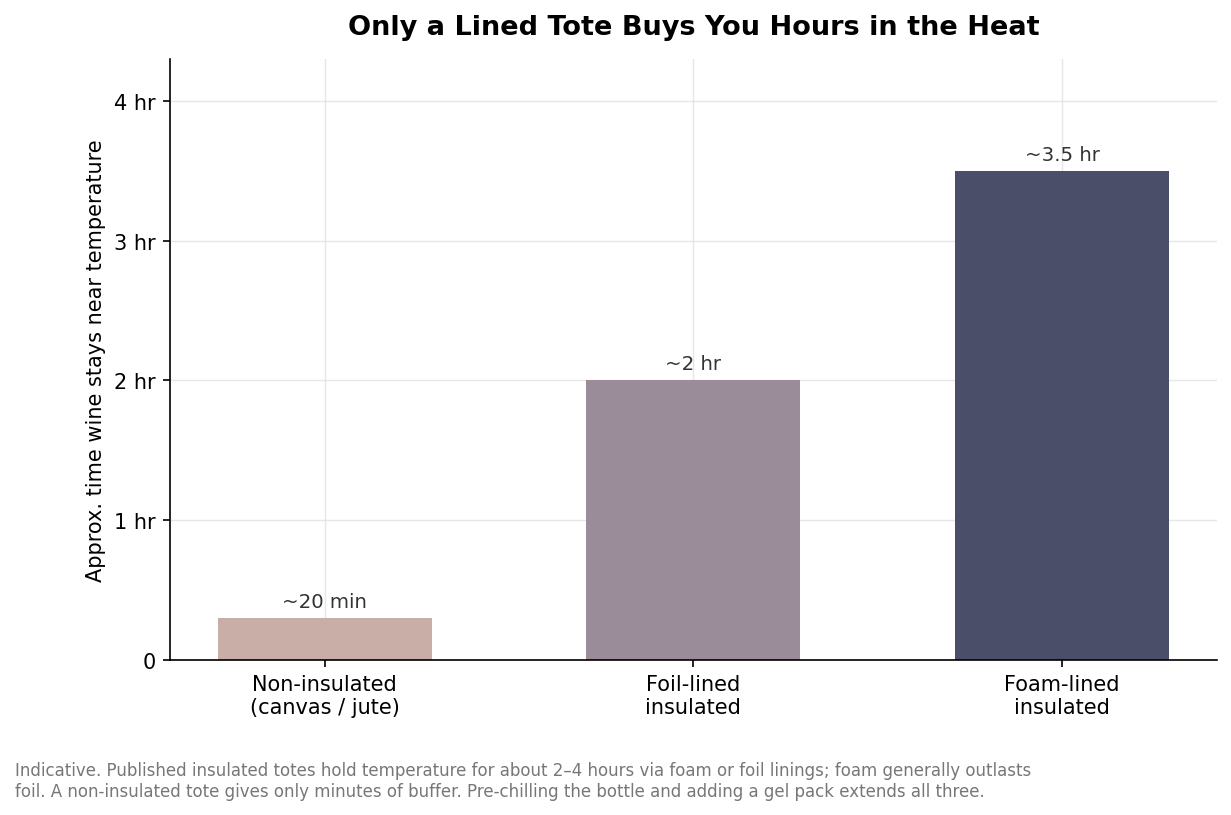
    The moment temperature enters the picture, insulation stops being a luxury and becomes the whole point. A foam- or foil-lined tote holds wine near its serving temperature for roughly two to four hours, which is the difference between a crisp white at an outdoor festival and a warm, flat disappointment.

    Bar chart comparing how long non-insulated, foil-lined, and foam-lined wine totes keep wine near temperature
    Only a lined tote buys hours of temperature protection; non-insulated fabric gives minutes.

    Foam linings generally outlast foil, and a non-insulated canvas or jute tote gives you only minutes of buffer before ambient heat takes over. Insulated totes commonly ship with sewn-in dividers and come in one-, four-, and six-bottle formats, with the same 300-use durability and roughly 200-unit minimums as non-woven. This is the right choice for warm climates, tailgates, poolside events, and any scenario where a customer faces a long, hot drive home from the tasting room. Two practical notes: pre-chill the bottle before it goes in, because insulation slows heat transfer but cannot cool a warm bottle, and add a slim gel pack when you need to stretch past a couple of hours.

    Then choose the format: one, two, four, or six bottles

    Once the material is settled, the format follows the trip. A single-bottle carrier suits restaurant BYOB visits, housewarming gifts, and one special bottle. A two-bottle tote is the everyday gift and dinner-party size, and it is the most common canvas format for good reason. A four-bottle bag fits family gatherings and wine-shopping trips where a customer wants a few choices, and a six-bottle carrier is the serious-collector and large-gathering option that demands robust construction because it can carry close to ten kilograms when full. Whatever the count, insist on double-stitched, reinforced handles and padded or stitched dividers on any multi-bottle format, since those two features are what separate a tote that survives a season from one that fails on its first heavy load. Order a printed sample in your chosen material and format before committing to the full run; a single proof confirms the fit, the print, and the build far more reliably than any spec sheet, including this one, whose figures are indicative and meant only to point you to the right tier.

  • The Complete Buyer’s Guide to Custom Wine Totes

    Wine totes are compared on bottle count and print area. Neither tells you anything about whether the glass survives the walk to the car.

    How wide are the cells?

    Cut to a named bottle, not to a capacity. Bordeaux is around 3 in, Burgundy nearer 3.4.

    An insert sized for the wrong one is discovered at the counter, not in the warehouse.

    How high do the dividers run?

    Full height, base to neck. The shoulder is the widest part and the part that clashes.

    Half-height card separates the bodies and lets the shoulders knock on every corner.

    How tall is the tote?

    Sides must clear the neck of the tallest bottle you carry, or bottles lever out.

    Sparkling and many Burgundy shapes are taller than the standard being assumed.

    What is the base?

    A reinforced board spreads eighteen pounds across the footprint instead of one bottle.

    Ask about the drop too — that is what keeps the glass off the ground.

    Then choose the colour

    Enjoyable, and safely secondary to the four above.

  • The Divider Is a Spare Part. Buy It Like One.

    In most tote programmes the insert fails years before the bag. Then the bag goes in the bin, because nobody sells the part that broke.

    What actually happens to an insert

    A leaking cork soaks it, and board never recovers its rigidity once it has been wet.

    A wide bottle forced into a narrow cell crushes the wall permanently.

    A soft insert is no insert

    Once it loses rigidity it stops holding bottles apart, which is its only job.

    The tote looks fine and has quietly stopped working.

    So order it separately

    Hold the cell dimensions on file and a replacement is one email.

    It is a consumable, and pricing it like one is cheaper for everybody.

    And use it to cover your range

    One shell, two insert specs: standard cells and wide tall cells for sparkling.

    Keyed so staff cannot seat them the wrong way round at the end of a long day.

  • Why Bottles Break in Wine Totes

    A tote that came back with a broken bottle is usually a tote that was doing exactly what it was built to do, which was not very much.

    Glass against glass

    Bottles lean on each other from the moment the tote is picked up.

    Without a full-height partition, the shoulders find each other on the first corner.

    The set-down shock

    A loaded six weighs about eighteen pounds and is put down hard, repeatedly.

    Whichever bottle stands on an unreinforced base takes that shock directly.

    Levering out

    Sides that stop at the shoulder let a bottle pivot on the rim on stairs.

    That is a dropped bottle rather than a cracked one, and it is entirely avoidable.

    The wrong cell width

    Forcing a wide bottle into a narrow cell crushes the divider permanently.

    After that the tote has no partition at all, and nobody notices until something breaks.

    What to ask for

    Cell width against your named bottle, divider height, internal height and base spec.

    Four lines on a quote, and they cost nothing to add.

  • Custom Wine Totes: How to Choose the Right Fabric, Material, and Format

    Custom Wine Totes: How to Choose the Right Fabric, Material, and Format

    If you’ve started pricing out custom wine totes for a tasting room, a wedding favor table, or a corporate holiday gift list, you’ve probably noticed the quotes swing wildly — anywhere from under a dollar a bag to seven dollars or more. That range isn’t random. It comes down to three variables: the material the tote is made from, how many you’re ordering, and how it’s printed. Once you understand those levers, you can stop guessing and start ordering the right bag at the right price.

    This guide walks through what custom wine totes actually cost by material, what minimum order quantities you’ll run into at different suppliers, and how far ahead you need to place your order so it arrives on time. All figures below come from current supplier pricing pages and industry breakdowns, cited where they’re used.

    Whether you need 100 single-bottle bags for a tasting room counter or 2,500 full-color totes for a distributor gift program, the numbers here should get you within striking distance of a real quote before you ever talk to a sales rep.

    What custom wine totes actually cost

    Per-unit price is driven almost entirely by material and order size. Non-woven polypropylene — the same material used in most reusable grocery bags — is the cheapest way to put your logo on a wine tote, and it’s the category most suppliers push people toward for events and giveaways where the bag isn’t meant to last for years.

    Cotton canvas and jute totes cost more per unit but read as a premium item, which matters if the tote itself is the gift rather than just packaging for one. Insulated totes, which add a foam or foil lining to keep bottles cool for a few hours, land in the same price band as jute because of the extra material layer.

    Printing adds to these baseline prices. Most quoted per-unit costs already include one-color, one-location screen printing; each additional ink color or print location typically adds a small per-unit charge for extra screen setup and press passes. If you want a full-color, photo-quality logo, you’re usually looking at a different production method — laminated non-woven material with a dye-sublimation or full-color transfer print — which comes with its own much higher minimum, covered below.

    Non-woven totes are the cheapest option per unit, but cotton canvas allows a smaller minimum order.
    Material Price per unit Typical minimum order
    Non-woven polypropylene $0.59 – $3.00 200 units
    Cotton canvas $2.48 – $5.93 100 units
    Jute / insulated $3.01 – $7.00 150–200 units
    Laminated non-woven (full color) Quoted per project 2,500 units
    Non-woven totes are the cheapest option per unit, but cotton canvas allows a smaller minimum order.Source: ReuseThisBag.com, “The Cost of Custom Wine Bags: A Wholesale Pricing Breakdown” and WineBags.com / Quality Logo Products product listings, 2026

    Choosing a material for your custom wine totes

    The right material depends on how the bag will be used after it leaves your hands. A wine club shipping insert or a one-time event giveaway doesn’t need to survive years of reuse, so non-woven polypropylene is usually the practical choice — it holds a crisp screen-printed logo, comes in single-bottle through six-bottle configurations, and keeps the per-unit cost low enough to hand out by the hundreds.

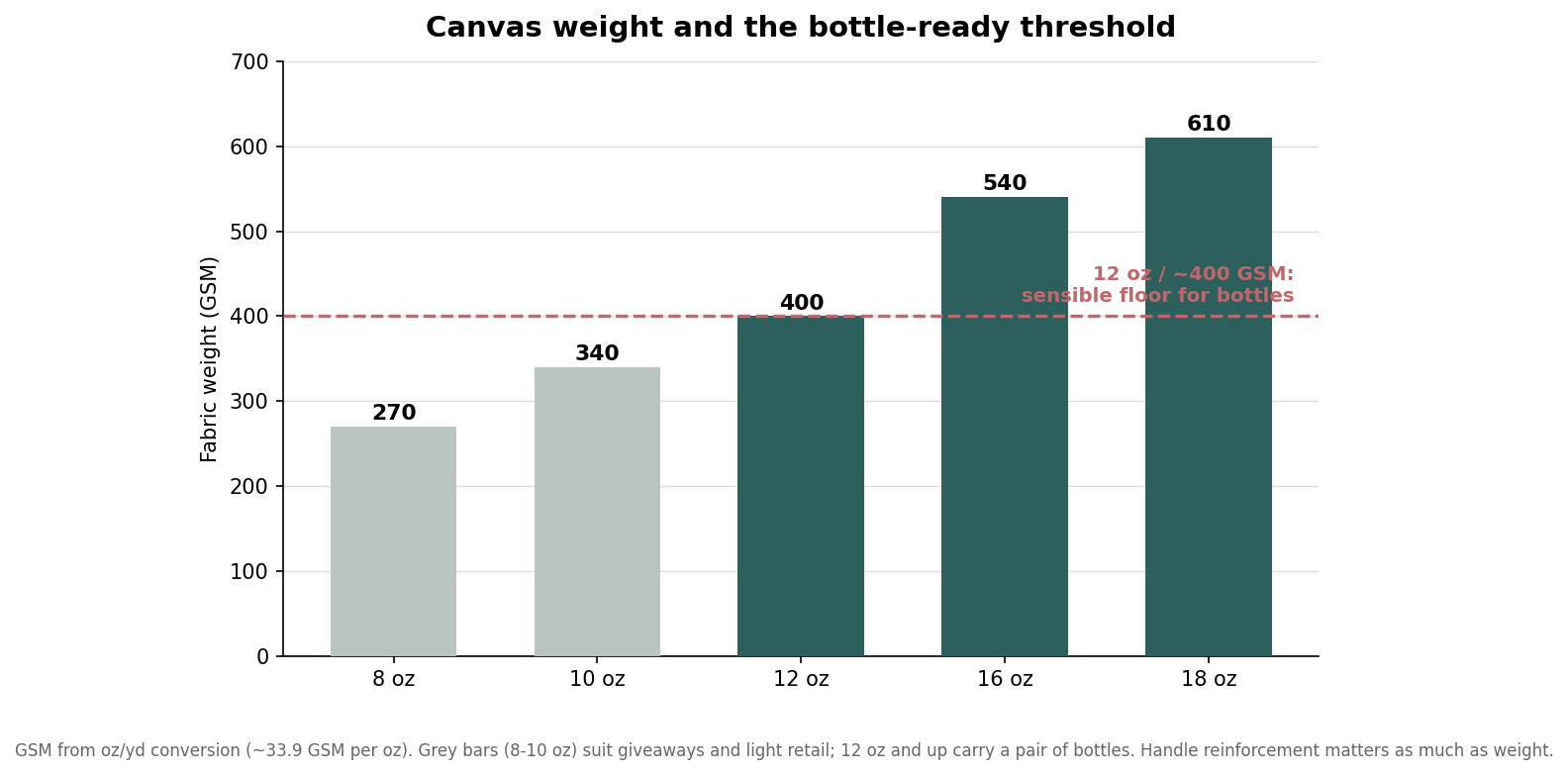
    Cotton canvas is the better call when the tote itself is the takeaway gift: think tasting-room retail, wedding welcome bags, or a wine club’s annual member gift. It has more visual weight, holds screen printing and embroidery equally well, and photographs better for social media unboxing content. Heavier canvas (10–12 oz) will cost more than lightweight canvas but holds its shape better with a full bottle inside.

    Jute brings a rustic, farm-to-table look that pairs well with organic or small-batch wine branding, though it’s coarser and less suited to fine-detail printing. Insulated totes are worth the premium only if bottles genuinely need to stay cool in transit — for anything shipped or handed out indoors, the insulation is paying for a feature nobody uses.

    Minimum order quantities: what’s realistic

    Minimum order quantities vary more by decoration method than by the bag itself. A plain screen-printed non-woven or cotton tote can often be ordered in quantities as low as 100, and a handful of suppliers will run small batches down to 50 units for an added setup fee. Once you move to full-color, photo-realistic printing on laminated material, minimums jump sharply — commonly to 2,500 units — because that process requires a larger print run to justify the plate and setup costs.

    If your real need is 150 bags with a sharp, multi-color logo, it’s worth asking your supplier for a quote on a four-color screen print (each color is a separate screen but the minimum stays low) before defaulting to full-color digital printing and its five-figure minimum. Most wineries and event planners never actually need photo-quality print resolution on a wine tote; a clean two- or three-color logo reproduces perfectly with screen printing at a fraction of the commitment.

    Lead times: how far ahead to order

    Budget more time than you think you need. Standard production for custom wine totes typically runs 10–15 business days after you approve the art proof, and that clock doesn’t start until the proof is signed off — not from the day you place the order. Shipping transit time is separate and additional on top of that window.

    Rush production is available from most suppliers for an added fee, and can bring turnaround down to as little as 2–6 business days depending on the decoration method and order size. If you’re planning for a specific event date, ask for that date explicitly rather than relying on a generic “rush” label, since some suppliers only guarantee rush shipping if the order is placed before a set cutoff time.

    November and December are the tightest months in the promotional products industry, with holiday order volume routinely extending standard lead times by one to two weeks. If your custom wine totes are earmarked for a holiday gift program, place the order by early October to leave room for a proof revision and any rush fees if something slips.

    Rush production can cut lead time by more than half, but peak season adds it back.
    Order type Typical turnaround
    Standard production 10–15 business days after proof approval
    Rush production 2–6 business days (fee applies)
    November–December peak season Add 1–2 weeks to either estimate
    Rush production can cut lead time by more than half, but peak season adds it back.Source: Aggregated production-timeline data from Custom Earth Promos, Deluxe.com, and GentlePK supplier pages, 2026

    Printing methods and Sizing

    Screen printing is the default for a reason: it’s durable, holds up to abrasion inside a wine fridge or car trunk, and is included in most base pricing for one color and one print location. If your logo has two or three flat colors, screen printing will reproduce it cleanly and cheaply. Gradients, photographic elements, or more than four colors push you toward full-color digital or dye-sublimation printing on laminated non-woven material, which looks sharper but comes with that much higher minimum order.

    Sizing follows the number of bottles the tote needs to carry. Single-bottle totes are the most common and most affordable configuration, sized to slip over one standard 750ml bottle with a carry handle or drawstring closure. Dual-bottle and multi-bottle totes (four- and six-bottle carriers with internal dividers) cost more per unit because they use more material and require reinforced stitching or a rigid divider insert to keep bottles from clinking together in transit. If you’re deciding between one six-bottle tote and six single-bottle totes for the same event, the single-bottle route usually stretches your budget further and gives each guest their own take-home item.

    Frequently asked questions

    What’s the cheapest way to order custom wine totes in bulk?

    Non-woven polypropylene totes with a single-color screen print are the least expensive option, typically running $0.59 to $3.00 per unit at a 200-unit minimum. Ordering to the next price break (often 250, 500, or 1,000 units) usually lowers your per-unit cost more than the extra units add in total spend.

    Can I order custom wine totes in quantities under 100?

    Some suppliers will run small batches below their posted minimum for an added setup fee, and cotton canvas styles in particular are sometimes available from a 100-unit minimum. Below that, expect a per-unit price premium since you’re not spreading setup costs across many bags.

    How far in advance should I order custom wine totes for an event?

    Plan for 10–15 business days of standard production after you approve the art proof, plus shipping time. If your event falls in November or December, add another one to two weeks and place your order by early October where possible.

    Is cotton canvas or non-woven material better for a wine tote?

    Non-woven polypropylene is more cost-effective and fine for one-time giveaways or event handouts. Cotton canvas costs more per unit but looks and feels like a premium item, which makes it the better choice when the tote itself is the gift rather than just a carrier for a bottle.

    Do custom wine totes require full-color printing to look good?

    No. Most winery and event logos are one to three flat colors, which screen print cleanly and stay within the low minimum order quantities of standard non-woven or cotton totes. Full-color, photo-quality printing looks sharper but usually requires a minimum order around 2,500 units.

    The bottom line

    The fastest way to get an accurate quote on custom wine totes is to walk in already knowing your material, your realistic order size, and your deadline. Non-woven totes at a 200-unit minimum keep costs near a dollar a bag; cotton canvas gives you a smaller minimum and a more premium feel for a few dollars more; and full-color printing is worth it only if you’re ordering thousands. Whatever combination fits your event or gift program, submit your art and approve the proof early — that single step controls more of your timeline than any rush fee can fix afterward.

  • Hello world!

    Welcome to WordPress. This is your first post. Edit or delete it, then start writing!